

Meeting transcripts transform into actionable engineering tasks through AI, bridging the gap between discussion and implementation. The traditional separation between planning and execution is blurring as AI helps translate ideas into code more fluidly.
Cross-functional collaboration is being reimagined as AI enables team members to contribute beyond their traditional domains. Engineers can now generate polished documentation, product managers can prototype features, and designers can suggest implementation details—all augmented by AI that understands multiple disciplines.
Impact Across Experience Levels
For junior engineers, AI provides solutions but requires guidance for effective integration. Mentorship becomes even more critical as AI can generate working code without conveying the underlying principles. Junior engineers who learn to effectively prompt and validate AI outputs gain significant leverage, but still need senior oversight to ensure best practices.
For mid-level and senior engineers, AI significantly reduces toil while freeing them to focus on architecture and design. These engineers extract the most value from AI tools as they spend significant time coding and possess the experience to evaluate model outputs effectively. AI helps them navigate unfamiliar technologies and languages quickly, expanding their technical versatility.
For staff+ engineers, AI serves as a research assistant and knowledge amplifier. In familiar domains, it provides modest productivity gains, but in unfamiliar territories, it dramatically accelerates learning and exploration, turning staff+ engineers into more versatile technical leaders. At this level, AI's impact on coding tasks may be less dramatic, but its ability to quickly synthesize information across disparate domains becomes invaluable for strategic technical decision-making.
Every Engineer Will Be an AI-Powered Engineer
As we look to the future, the distinction between ‘AI engineers’ and regular ‘software engineers’ will increasingly blur. AI will become the default approach to software development—as fundamental as version control or automated testing—simply a part of every engineer's standard toolkit.
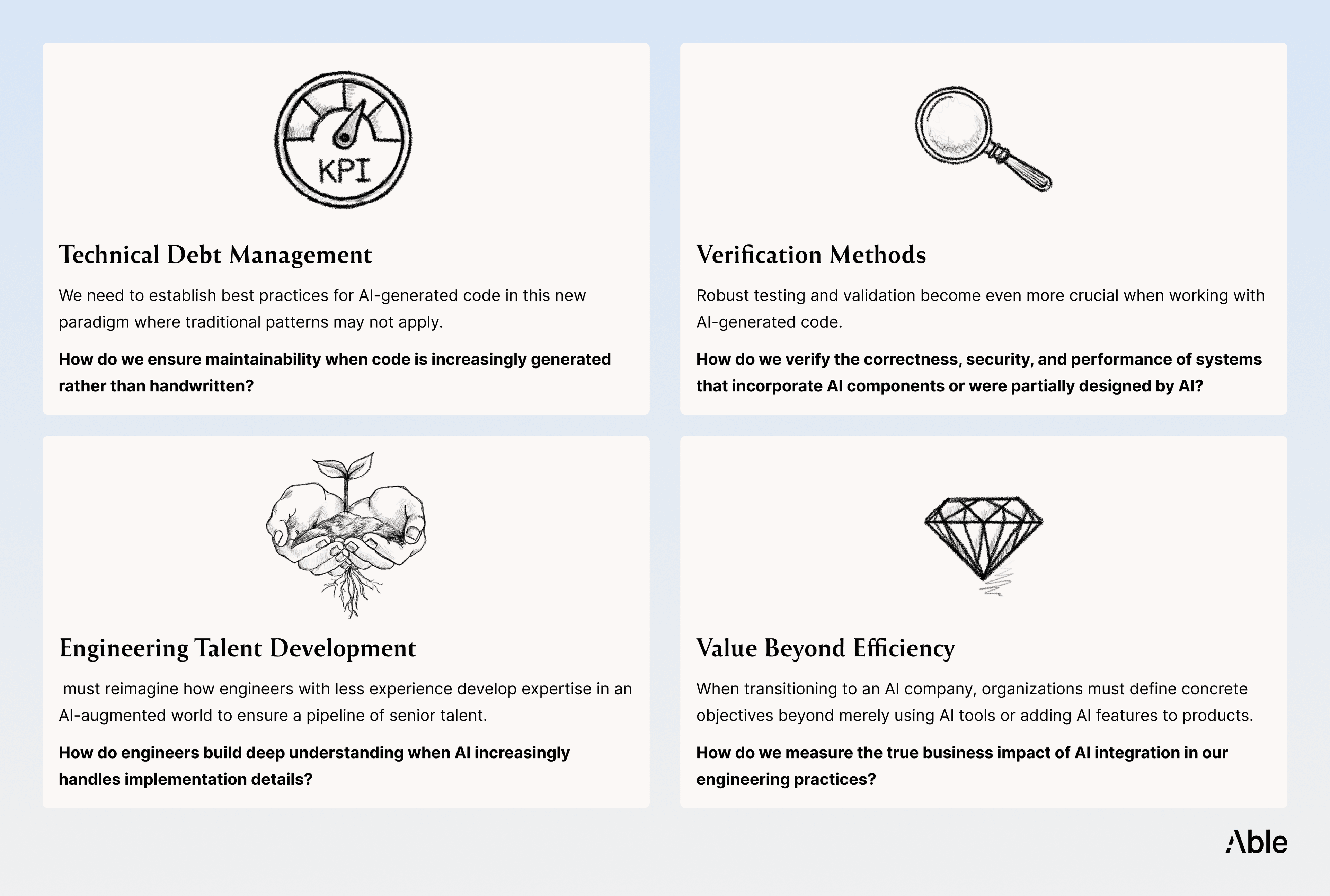
As we integrate AI into our engineering practices, here are a few areas we should keep an eye on:
Collective Intelligence
The most forward-thinking organizations are already evolving beyond viewing AI as just sophisticated tools. The next stage in this journey involves building true collective intelligence through agentic workflows—where AI systems become active participants in the development cycle rather than passive assistants waiting to be prompted.
To move forward today, consider these actions:
- Identify one end-to-end workflow in your development process that could benefit from an agentic approach
- Build guardrails that ensure human oversight at critical decision points
- Create metrics that measure not just speed improvements but quality outcomes
- Develop a framework for engineers to effectively collaborate with AI agents
The question isn't whether your engineers will work alongside AI agents, but how deliberately you'll design these partnerships to amplify your team's unique strengths.


